
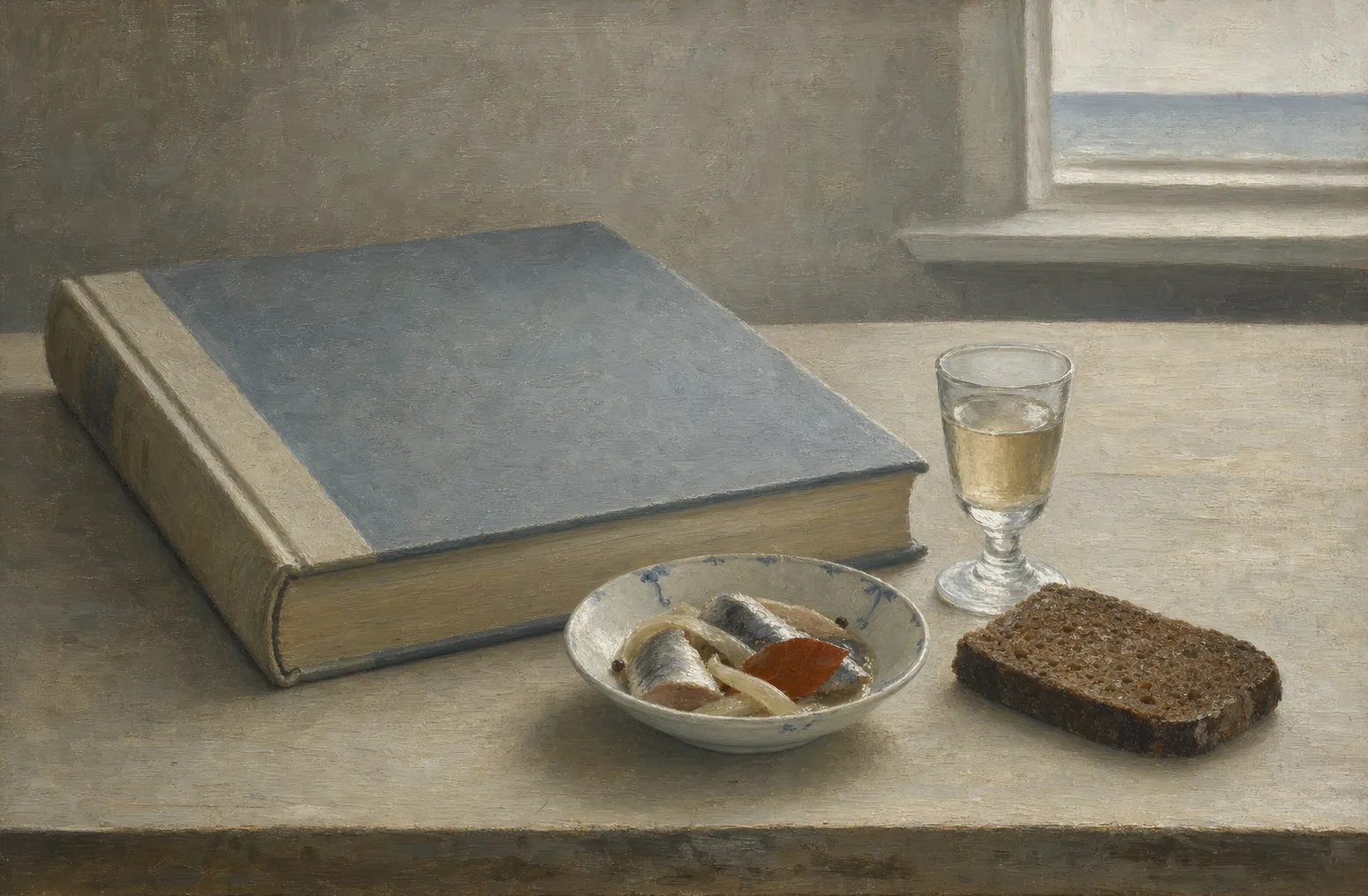
The conservas conversation in the United States has a geography problem. It is almost entirely Iberian. The tins you see at wine bars, the brands reviewed in food media, the vocabulary you absorb when you get serious about this category — it is Cantabrian anchovies, Galician razor clams, Portuguese sardines. Spain and Portugal have earned that attention. But the fixation has a cost: it makes an entire continent’s preserved fish tradition invisible. Magnus Nilsson’s The Nordic Cookbook is the corrective. It is 768 pages and it weighs four pounds and it will make you feel that the Iberian coverage you have been reading, including some of what appears on this site, is incomplete in an important way.
Nilsson was the chef of Fäviken, the remote Swedish restaurant that sat in a converted granary on a six-thousand-acre hunting estate and, before it closed in 2019, held two Michelin stars and was on the World’s 50 Best list. His cooking was rooted in extreme locality — everything from within a day’s drive, in a climate that produces snow for half the year — and in the preservation techniques that Nordic cultures developed out of necessity before refrigeration existed. Gravlax is not an invention; it is a two-thousand-year-old solution to a supply problem. Surströmming (Swedish fermented herring, the one you may have seen as a YouTube challenge) is not a joke food; it is a product of sophisticated microbiology developed when salt was too expensive to use in quantity. Rakfisk, Norwegian fermented trout, is first recorded in the fourteenth century. The Nordic tradition of preserved fish is not a counterpart to the Iberian tradition. It is older.
The book contains more than twenty pages of herring recipes alone. Not a chapter on herring — twenty pages of recipes for a single species, pickled, marinated, salt-cured, smoked, fermented, baked, fried, and combined with everything from cream and dill to juniper and whey. There is step-by-step instruction on how to make gravlax, how to cure mackerel, how to smoke salmon at home. There are recipes for Janssons frestelse — the creamy potato and anchovy casserole that appears at every Swedish Christmas table — that make clear the anchovy is not a flourish or an upgrade but a structural element the dish literally does not work without. The narrative text throughout runs to over 130,000 words, which is to say this is a book that explains what it is doing and why, not just a recipe collection with atmosphere.
The honest limitations need naming. The book is enormous and, for a weeknight cook, functionally unusable as anything other than a reference. Many of the recipes require ingredients that are difficult or impossible to source in America — certain fish species, specific cured meats, regional varieties of rye bread. Some of the preservation methods require weeks or months, fermenting equipment, and the kind of cold cellar that most American homes do not have. Nilsson is not apologetic about this. The book’s ambition is documentation and argument, not accessibility, and if you go in expecting a practical recipe guide you will be disappointed.
Use it as a reference. Use it as an argument. When someone tells you that tinned and preserved fish is an Iberian thing, hand them this book opened to the herring chapter and let twenty pages of pickled herring recipes do the work. The Nordic tradition is not coming later in this category’s American arc — it is already here, in every grocery store smoked salmon, every canned mackerel in water, every jar of herring in cream sauce at the Swedish specialty counter. Nilsson’s book is the explanation for what it means.
We will write a dedicated guide to Northern European tinned fish for this site. When it exists, this book will be the first citation.
Where to buy
- Amazon Buy at Amazon
- Bookshop.org Buy at Bookshop.org
As an Amazon Associate, The Tin Guide earns from qualifying purchases.