
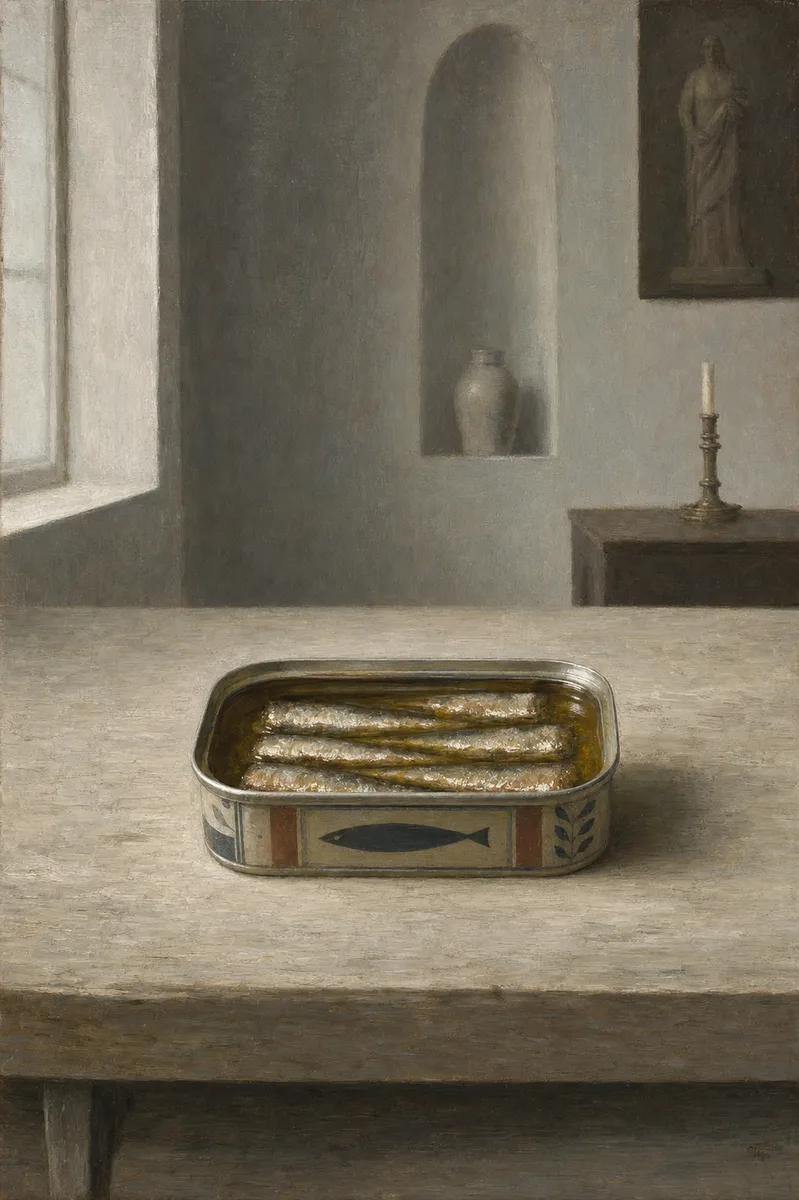
There is a question worth asking before any sardine review: what does a sardine this good actually prove? Conservas Pinhais, a family-run cannery in the Portuguese port town of Matosinhos, has been answering that question since 1920, and the answer is the same now as it was then. Every fish is cut by hand. Every tin is packed by hand. The paper wrapper — that particular detail, which distinguishes the Pinhais tin on sight before you open it — is not a nostalgic affectation. It is a signal that you are holding something that was made by people who have not yet accepted the argument that machines do it well enough.
Four dollars separate a tin of Nuri from a tin of Pinhais at most American specialty retailers. That is the relevant comparison, not the comparison to some hypothetical worse sardine. Nuri is good — we have said so, and we mean it. Pinhais is different in kind, and those four dollars are the most defensible gap in the category.
Tasting notes
- Whole sardines arranged head-to-tail in a luminous, golden-green olive oil. The skin is intact and burnished, the flesh a warm silver-grey with no bruising, no collapse. Portuguese olive oil carries a greenness that paler Iberian oils don't — it is visible in the tin before the first bite.
- Sea-fresh and clean, with a faint herbal note from the oil. The brine is present in the background without announcing itself. Nothing smells pickled or processed.
- Firm at the surface, yielding at the center — the characteristic of a sardine that has been heat-processed carefully rather than blasted into compliance. The spine releases cleanly. The flesh flakes in long sections rather than crumbling.
- Rich and oceanic, with more depth than the aroma suggests. The fish and the oil are genuinely integrated — neither is a passenger. A salinity that sits at the back of the palate rather than the front, and a long, clean finish that doesn't fade into fishiness. This is what a sardine tastes like when nothing goes wrong.
The Pinhais cannery functions today in roughly the way it has for a century: a team of caneiras — the women who have traditionally handled the packing work — filling each tin by hand, orienting each fish, pressing the lid. The cost of that labor shows up in the price and nowhere else visible. You cannot see the hand-packing in the finished tin, but you can taste its consequence: a consistency and care that fully automated lines produce only in approximation. There are no broken fish. There are no fillets packed at a wrong angle that force you to extract the rest sideways. Each tin is the same because each tin was made by someone who noticed.
When the Don Bocarte review concluded that the Ortiz premium was justified but the Don Bocarte premium wasn’t, the argument was about whether the gap in quality matched the gap in price. The Pinhais case is the inverse. Four dollars over Nuri buys you a materially different sardine — different in texture, different in oil quality, different in finish. Nuri is the right answer to the question “what’s a good value sardine I can keep in the pantry.” Pinhais is the right answer to a different question: what is the best sardine I can buy.
The verdict
9.3 / 10The sardine equivalent of the Ortiz anchovy: the reference standard for the category, the tin every other sardine is measured against. Buy Nuri for the pantry. Buy Pinhais when you want to taste what the category is actually capable of.
Where to buy
- FishNook · $11 Buy at FishNook
- Amazon · $12 Buy at Amazon
As an Amazon Associate, The Tin Guide earns from qualifying purchases.