
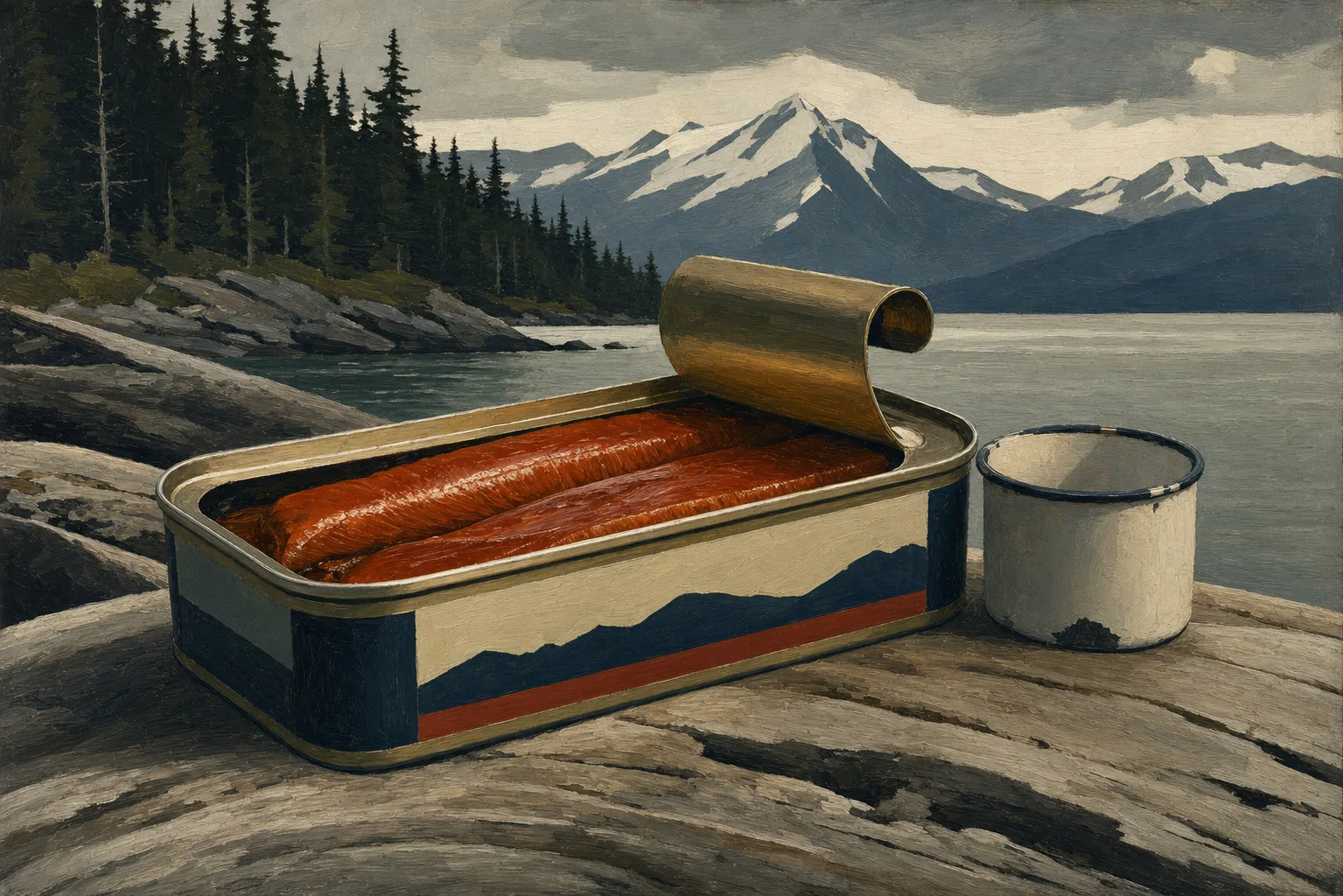
Sitka, Alaska is a fishing town on Baranof Island in the Southeast Alaska archipelago. It is not a place with a convenient highway out, and it does not have the supply-chain convenience of, say, a salmon processing facility in the Pacific Northwest with easy container access. The geography is the point. Wildfish Cannery operates in Sitka because that is where the fish are — king salmon from the waters around Southeast Alaska, wild-caught, the species that has no industrially farmed equivalent worth comparing to the real thing. The current owners took over around 2008 and made one clear decision: hand-pack every tin, smoke with alder, use olive oil. That is the entire ethos, and it is sufficient.
The price is twenty-two dollars. This is the most expensive American-made tinned salmon we have reviewed, and the comparison to Fishwife’s smoked Atlantic salmon — which we scored at 8.7 and priced at fourteen dollars — is the structural obligation of this review. We will get there.
Tasting notes
- Large, substantial chunks of salmon in a warm amber-orange, packed in a clean, pale olive oil. King salmon is a fatty fish, and the intramuscular fat is visible as white marbling through the deep orange flesh — this is not a cosmetic quality, it is the source of the flavor. No paste, no filler, no uniform compression.
- Alder smoke, restrained and woody rather than liquid-smoky. The salmon underneath is forward and oceanic, not masked. There is a faint sweetness — the natural fat of the king — that comes through the smoke and signals what is waiting.
- Substantial and yielding in long, clean flakes. King salmon has more structural integrity than Atlantic salmon, and the hand-packing preserves it — you are lifting recognizable pieces of fish, not reconstituted fragments. The olive oil keeps the flesh supple without making it slick.
- Deep, fatty, and complex in a way that Atlantic salmon farmed for consistency cannot replicate. The alder smoke is integrated, not applied — it is part of the flavor of the fish rather than a coating on top of it. The finish is long and savory, with a clean richness that stays. Salt level is measured; the fish does the work.
The Fishwife comparison. Wildfish scores 9.0; Fishwife scores 8.7. Those three tenths of a point are real — Wildfish is a materially better tin, and the king salmon’s natural fat content produces a depth of flavor that Atlantic salmon at any price point cannot fully replicate. But the decision framework for a buyer is not which is better in the abstract. It is: what do I actually buy?
Fishwife is fourteen dollars, available on Amazon with Prime shipping, and consistent enough to stock as a pantry anchor. Wildfish is twenty-two dollars, available primarily direct from Sitka or through specialty retailers, and it will occasionally sell out of specific batches. The eight-dollar delta and the logistics gap together mean this: Fishwife is the answer to “what tinned salmon do I keep in the house.” Wildfish is the answer to “what is the best tinned salmon made in America.” Both questions are worth answering, and the answers are different. This is not hedging — it is what a guide is for.
Wildfish also makes canned rockfish, smoked sockeye, coho, octopus, geoduck, and gooseneck barnacles. The barnacles and geoduck alone are the signal: these are fish people running the operation, not a brand that happens to sell salmon. The king salmon tin is the flagship and the argument. What it argues is that American canneries, given the right fish and the right intention, can make something as serious as anything from Spain or Portugal. Wildfish makes that argument without needing to say it.
The verdict
9.0 / 10The ceiling of American tinned salmon. Buy it when you want to taste what the category is capable of in the US, or when you are serving someone who will notice the difference. For everyday stocking, Fishwife at fourteen dollars is the right call. For the occasion that warrants it, this is the one.
Where to buy
- Wildfish Cannery · $22 Buy at Wildfish Cannery
- FishNook · $24 Buy at FishNook